

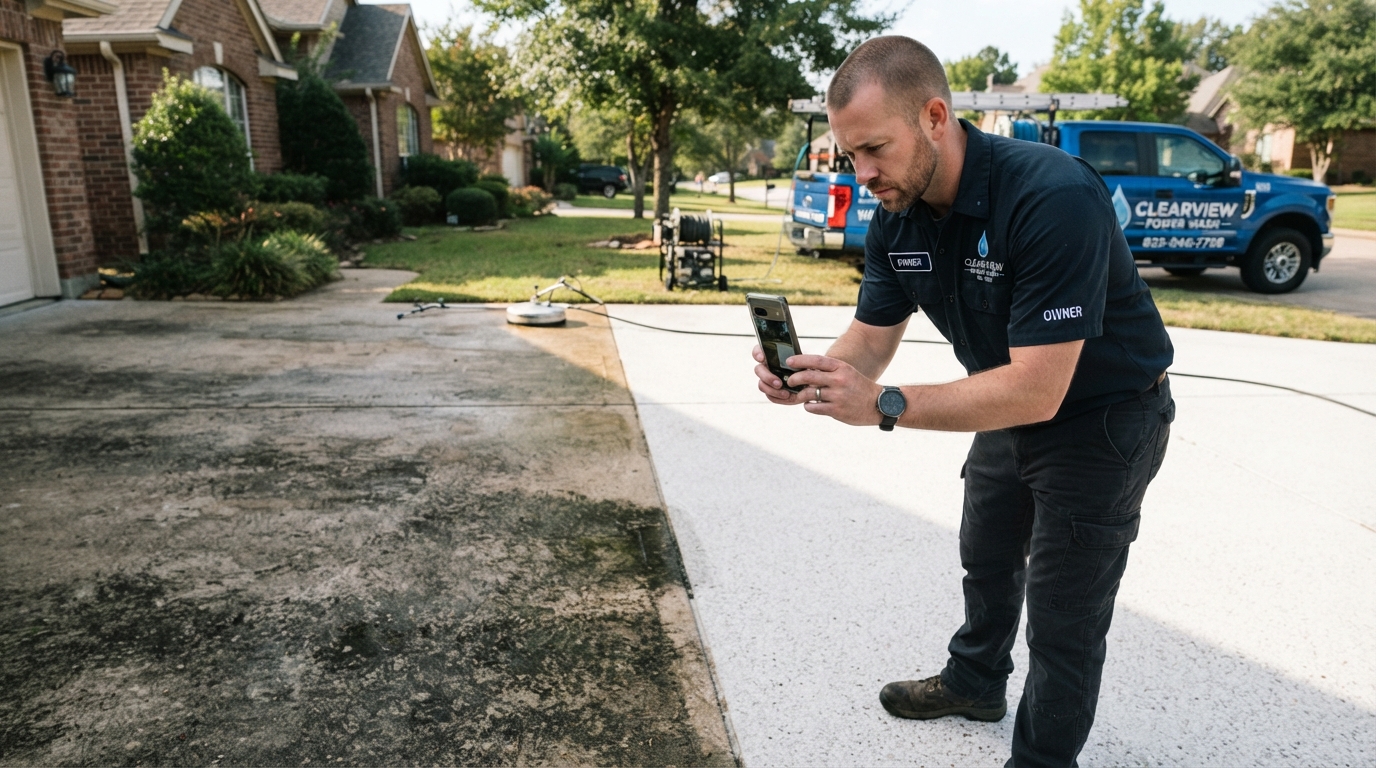
Scaling an exterior cleaning operation beyond the owner-operator stage requires consistent lead generation, smart hiring, operational systems, and a brand that commands premium pricing. This is the revenue-first playbook for contractors who are serious about building a real company.
Most pressure washing businesses plateau. The owner is working 50+ hours a week, the schedule is inconsistent, and every attempt to grow hits a wall. More leads without systems create chaos. Hiring without a brand creates constant undercutting on price.
The operators who break through do it the same way every time. Here’s what they do differently.
Stage 1: Define Your Target Market and Service Focus
Before you can grow, you need to know exactly who you’re growing toward. Your target market shapes every decision: your pricing, your marketing channels, your service offerings, and how you position your brand.
For most contractors starting out, the clearest target market is residential homeowners in a specific geographic area. This is where repeat business comes easiest, where word of mouth spreads naturally, and where you can build a loyal client base quickly with consistent service quality.
Once you have a strong residential base, commercial property owners and managers become the next logical expansion. Commercial property clients mean larger jobs, fewer customers to manage, and recurring contracts that generate predictable revenue. Rental companies — property management firms managing apartment complexes, retail spaces, and commercial buildings — are particularly strong targets because they have ongoing, regular maintenance needs across multiple properties.
Choose a target market. Build your systems around it. Don’t try to be everything to everyone before you’ve dominated one segment.
Stage 1b: Get the Business Foundation Right
Before you can grow, your business needs to be set up correctly. Skipping this step creates expensive problems later.
Business Structure and Registration
Register your business as an LLC or corporation. This separates your personal assets from business liabilities — essential in a physical service industry where equipment accidents and property damage claims happen. An LLC requires an EIN (Employer Identification Number) from the IRS, which you can apply for free online. Unlike a sole proprietorship, you don’t use your social security number as your business tax ID when you operate as an LLC or corporation — you use the EIN instead.
Licensing and Insurance
Licensing requirements vary by state and city. Some jurisdictions require a contractor’s license for pressure washing work; others don’t. Research your local requirements before your first commercial job — many property managers and HOAs require proof of licensing and insurance before they’ll hire you.
At minimum, carry general liability insurance and a commercial auto policy. Workers’ compensation is required as soon as you hire your first employee in most states. Many business owners skip this until they’re larger — that’s a mistake. A single property damage claim without insurance can wipe out years of revenue.
Business Banking and Bookkeeping
Open a dedicated business checking account immediately. Mixing personal and business finances creates accounting nightmares and undermines your credibility with commercial clients. Set up basic bookkeeping — even a simple spreadsheet — to track income, expenses, and job costs from day one. Regular maintenance of your financial records makes tax time simple and gives you the data you need to make pricing decisions.
Stage 2: Build a Lead Engine Before You Scale
The most common growth mistake is trying to scale operations before lead flow is stable. Before you hire a second crew, you need a system that generates consistent, qualified leads without your personal hustle being the bottleneck.
The three most reliable lead channels for pressure washing companies:
Google Business Profile + Local SEO
When someone searches for services in your city, your Google Maps listing is the first thing they see. Companies that invest in their local SEO and Google Business Profile build a lead engine that works 24/7 without ongoing ad spend. This takes 3–6 months to build, but the ROI compounds indefinitely.
Google Ads and Local Service Ads
Google Ads and Local Service Ads (LSAs) put you at the top of search results immediately. LSAs in particular — with the “Google Guaranteed” badge — convert at exceptionally high rates for home services. This is paid digital marketing that generates leads while your organic rankings develop.
A High-Converting Website
Your website is where leads either convert or leave. A professional, conversion-optimized website built for exterior cleaning companies — fast, mobile-friendly, with clear CTAs and trust signals — turns your traffic into booked jobs. A weak website wastes every dollar you spend on ads and SEO.
Stage 3: Understand Your Upfront Costs and Pricing
Sustainable growth requires financial clarity. Know your upfront costs: equipment, vehicle expenses, insurance, and initial marketing spend. Know your break-even point per job. Know what you need to charge to cover overhead, pay yourself, and have margin left to reinvest.
Many contractors undercharge because they haven’t fully accounted for all their costs. When you know your actual cost per job — including drive time, fuel, equipment depreciation, insurance, and overhead — you can price confidently and stop worrying about being undercut by competitors who are probably losing money at their rates.
Graffiti removal, fleet washing, and post-construction cleaning typically command premium pricing because they’re specialty services with higher perceived value. Adding even one specialty service to your menu can meaningfully increase your average job value without significant additional investment.
Stage 4: Systematize Before You Hire
Before adding your first employee or second crew, document your processes:
- Job workflow: How does a job go from lead to quote to booked to completed to invoiced?
- Quoting standards: How do you price? What’s in every quote? How fast do you follow up?
- Quality standards: What does a completed job look like? What do you check before leaving a site?
- Customer communication: What does the customer receive at each stage — confirmation, reminders, follow-up?
- Regular maintenance schedules: How do you track which customers are due for recurring service?
Use a job management platform (Jobber, Housecall Pro, etc.) to enforce these workflows. Systems that exist only in your head cannot scale.
Stage 5: Hire and Train Right
Your first hire is the hardest. Most pressure washing owners make this hire when they’re already overwhelmed — which means they hire fast, train poorly, and are disappointed with the results.
Hire slightly before you’re overwhelmed. Train obsessively. The standard you accept from your first employee becomes the standard of your business.
Pay competitively. The best workers in this industry have options. Cheap labor costs more in callbacks, customer complaints, and churn than paying fairly upfront. Attract the right people with fair pay, consistent hours, and a company they’re proud to represent.
Stage 6: Build a Brand That Commands Premium Pricing
Owner-operators competing on price will always be undercut by someone. The companies that grow to $500K+ in annual revenue aren’t the cheapest — they’re the most trusted, most visible, and most professional.
Building that brand means:
- Professional logo and branding on trucks, uniforms, and materials — customers notice
- Consistent Google reviews — 50+ reviews at 4.8+ stars builds price-justifying credibility
- Active social media and digital marketing showing your work, your crew, and your results
- A strong online presence — website, Google, and ads that make you look like the category leader in your market
Your logo and brand identity are more important than most operators realize. A truck wrap and professional branding change how customers perceive your price point before they’ve spoken to you.
Stage 7: Build Repeat Business and Referral Engines
The most profitable companies in this industry don’t just attract clients — they keep them. Repeat business from a loyal client base costs a fraction of what new customer acquisition costs.
Build systems to drive repeat business:
- Automated follow-up at 6- and 12-month intervals for residential customers
- Quarterly or annual maintenance plans that customers pre-commit to
- Referral programs that incentivize happy customers to spread the word
- Post-job reviews that build your Google ranking and reputation simultaneously
A customer referred by a satisfied client closes at dramatically higher rates than a cold lead. Systematize the referral ask and it becomes a reliable, low-cost lead channel.
Stage 8: Add Revenue Streams
Growing a business in this industry doesn’t just mean more jobs of the same type. It means expanding what you offer strategically:
- Roof soft washing
- Window cleaning
- Gutter cleaning
- Commercial contracts and recurring service agreements
- Fleet washing for local businesses
- Graffiti removal (premium-priced specialty service)
- Holiday light installation (strong seasonal revenue in Q4)
Adding services to an existing customer base is far cheaper than acquiring new customers for a single service. Every upsell to a current customer is a sale you didn’t have to market for.
Helpful Resources, Tools, and a Good Starting Point
Here’s a practical starting point checklist for operators who want to accelerate their growth:
- Business plan with executive summary: A one-page executive summary of your business — your target market, your services, your revenue goals, and your marketing plan — forces clarity and makes it easier to make decisions. It doesn’t have to be a formal 20-page document. A clear executive summary you reference monthly is more useful than a comprehensive plan you write once and never look at.
- Helpful resources for scheduling and billing: Jobber, Housecall Pro, and similar platforms offer free trials and helpful resources (guides, support docs, webinars) specifically for cleaning contractors. Use these to get your systems running before you hire.
- A loyal client base before scaling: Don’t add crew before you have a loyal client base of 30–50 regular customers who book consistently. These are your revenue foundation. Scaling on top of inconsistent demand creates stress and churn. Build the loyal client base first.
- Commercial property outreach strategy: Identify 20 commercial property addresses in your area where the exterior cleaning is visibly overdue. Build a simple outreach plan: a direct mail letter, a follow-up visit, and a LinkedIn connection to the property manager. Repeat business from commercial property clients funds consistent growth.
- Graffiti removal as a premium add-on: Graffiti removal is a high-ticket specialty service that most general cleaning companies don’t offer. If you have the equipment and chemistry for heavy duty projects like graffiti, promote it actively. The margins are excellent and the competition is thin in most markets.
- Attract clients with a content strategy: Blog posts, Google Business Profile updates, and social media content consistently attract clients who are researching cleaning services. An operator who publishes helpful, searchable content — “how to maintain a concrete driveway,” “when to schedule regular maintenance cleaning,” “how to choose a cleaning company” — attracts clients who are already educated and easier to close.
- Digital marketing investment schedule: Map out your digital marketing investment for the next 12 months. What will you spend on Google Ads? On local SEO? On social media ads? Building a plan ahead of time means your marketing is consistent even during slow months — which is exactly when you need it most.
Revenue Benchmarks
- Solo owner-operator: $80K–$150K annual revenue
- 1–2 crews: $200K–$400K
- 3–5 crews: $500K–$1M+
- Multi-location: $1M+
Each stage requires different systems, team structure, and digital marketing investment. The operators who grow fastest treat marketing as a fixed cost of doing business — not something they turn on when they’re slow.
Handling Heavy Duty Projects and Specialty Services
As your business grows, you’ll encounter heavy duty projects that require more than a standard residential wash: industrial facility cleanups, large commercial parking lots, fleet washing programs, and graffiti removal. These heavy duty projects command premium pricing and require appropriate equipment, chemistry, and technique.
Expanding into heavy duty projects is one of the fastest ways to increase average job value without adding proportionally more marketing spend. A commercial fleet washing program or industrial equipment cleaning contract can represent as much revenue as 20–30 residential jobs. If your equipment and team are capable, marketing toward heavy duty projects — through targeted outreach to industrial businesses, fleet operators, and commercial property managers — can dramatically change your revenue mix.
Graffiti removal in particular is a high-margin specialty service with limited competition in most markets. It requires specific chemistry and technique, but the barriers to entry keep most operators away — which means less price competition for operators who do it well. If you invest in the training and materials, marketing this service through Google Ads, your website, and direct outreach to commercial property owners can generate premium revenue with minimal competition.
Frequently Asked Questions
Build your Google presence first — Google Business Profile, local SEO, and Google Ads. These three channels together create consistent inbound leads from people actively searching for your services. Complement with direct outreach to commercial property and rental companies for higher-value accounts.
Most operators can build a profitable solo operation in 1–2 years. Scaling to multi-crew operations typically takes 3–5 years of intentional growth. The speed depends heavily on how aggressively you invest in digital marketing and systems early.
Start where you can build a reputation and reviews quickly — for most operators, that’s residential. Use the residential base to build credibility, then attract clients in the commercial segment for higher revenue per job and recurring income.
Underinvesting in digital marketing. Most owners think they’ll grow through word of mouth alone. Word of mouth is slow and unreliable as a growth strategy. The companies that scale fast invest in a marketing engine that generates leads predictably — website, SEO, and paid ads working together.
Growing this type of business requires a stable lead engine, documented systems, disciplined hiring, and a brand that commands what you’re worth. The operators who do all four consistently are the ones who end up owning their market.
If you’re ready to build a marketing engine that supports real growth, let’s talk about what that looks like for your business.