

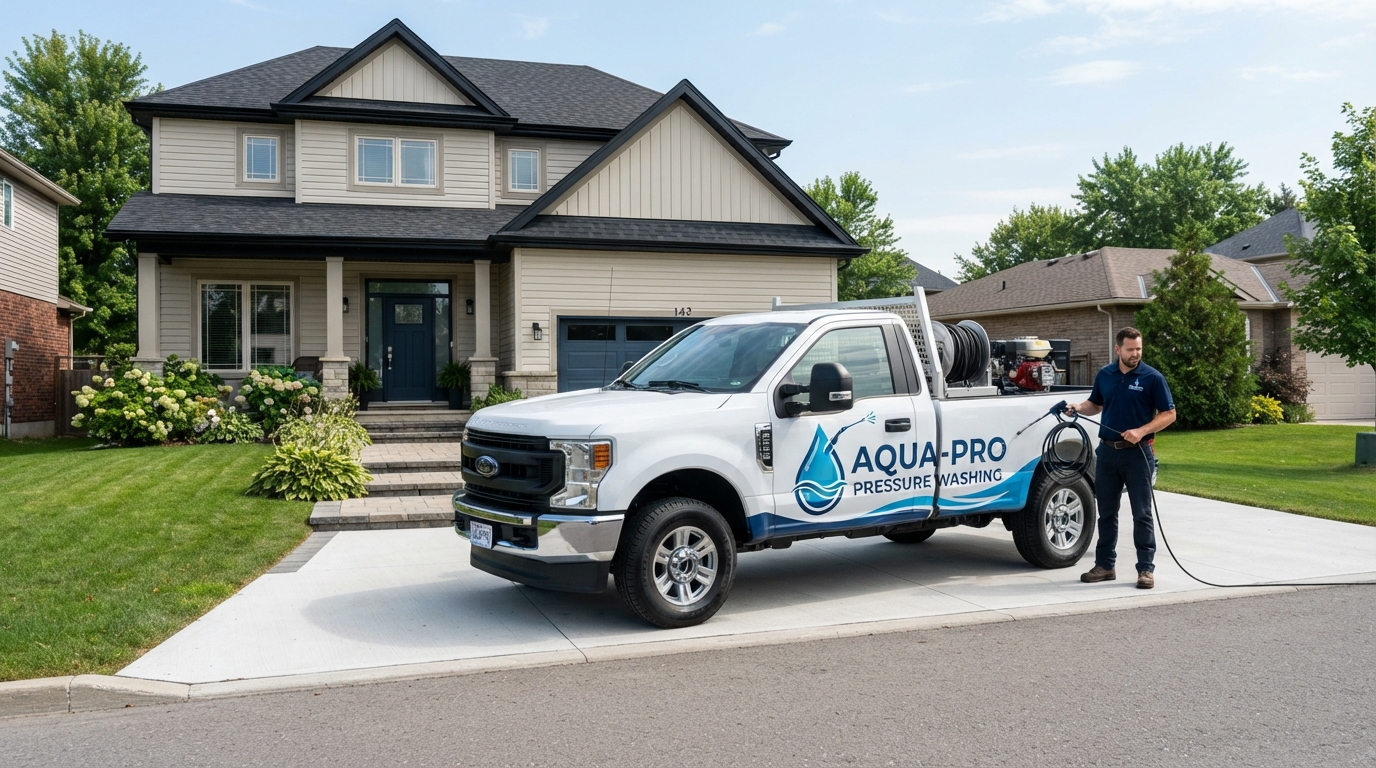
In this industry, most companies look the same: a truck, a phone number, and a generic website. Building a real brand — a recognizable name, consistent visual identity, and professional marketing strategy — makes you the obvious choice before a homeowner ever calls. Here’s how to build it.
Price competition is brutal in this space. There’s always someone willing to undercut you. The way out isn’t to be cheaper — it’s to build a brand so strong that price becomes a secondary concern.
When homeowners see a professional truck wrap, a 5-star Google listing with 80 reviews, a polished website page, and targeted ads in their neighborhood — they’re not calling three companies for quotes. They’re calling you.
What Branding Actually Means for a Pressure Washing Company
Branding isn’t just your logo. It’s the sum of every impression a customer forms about your business — before, during, and after a job. For an exterior cleaning company, that includes:
- The visual identity (logo, colors, fonts) applied consistently everywhere
- The way your trucks and uniforms look when you pull up to a job
- The tone and professionalism of your website page and service pages
- How fast and professionally you respond to inquiries and messages
- The quality of your before/after photos across Google, social, and your website
- Your review count and how you respond to them publicly
Each of these is a branding decision, even if you’ve never thought of it that way. Creating a consistent experience across all of them is what separates a recognizable company from a nameless truck in a neighborhood.
Build a Clear Marketing Strategy First
Before creating anything, define your marketing strategy. A strategy answers three questions:
- Who are you targeting? Residential homeowners? Commercial property managers? A specific neighborhood or city?
- What makes you different? Speed, quality, professionalism, specialization, guarantee?
- What does success look like? Weekly lead volume? Revenue target? Market share in a specific area?
Without a clear strategy, your branding and marketing efforts scatter. A focused strategy means every dollar you spend on advertising, your website page, and content is pointed at the same target. That’s what makes marketing efficient instead of expensive.
Start With a Professional Logo and Visual Identity
Your logo is the foundation of your brand strategy. It goes on your truck, your uniforms, your website, your invoices, and your marketing materials. A generic DIY logo signals a generic DIY business to homeowners and commercial clients alike.
A professional logo and brand identity designed for your specific market position does two things: it builds credibility with customers before they’ve spoken to you, and it defines how you want your company to be perceived. Investing money in a strong logo and visual system is one of the highest-ROI early decisions you can make — it pays back every time a truck rolls by, every time a homeowner visits your website page, every time a customer opens your invoice.
Don’t fall into the trap of thinking you’ll fix the logo later. It’s hard to undo once it’s on your equipment and printed materials. Get this right early.
Brand Your Vehicles and Equipment
Your trucks are moving billboards in the neighborhoods you serve. A professional truck wrap — with your logo, website, and phone number — generates impressions every day without any ongoing cost. Homeowners who see your truck in their neighborhood are pre-sold before they ever visit your website page or call.
Branded equipment and uniforms also change what customers are willing to pay. A truck with a well-designed wrap suggests a legitimate, professional operation. A truck with a magnetic sign suggests a side hustle. Which company do you think can charge more without homeowners pushing back on cost?
Build a Website That Reflects Your Brand and Converts Leads
Your website is where branding converts into booked jobs. A professional website that reflects your brand identity — your colors, your photography, your strategy — makes a fundamentally different impression than a generic template page. It also ranks better in Google with proper local SEO.
When homeowners search for services in your area, your website is often the first real interaction they have with your brand. A site that looks polished and professional removes the worry about whether you’re a legitimate business. A site that looks like it was built in 2015 creates that worry — and costs you the job before you’ve spoken.
Own Your Online Reputation as a Core Strategy
Reviews are the most powerful branding signal a local service company has. A company with 80 five-star Google reviews looks like the market leader — regardless of how long they’ve been in business. Homeowners don’t worry about cost as much when the social proof is overwhelming.
Creating a review-generation system requires no ongoing effort once it’s set up:
- Ask every happy customer at job completion for a Google review
- Send a direct review link via text — don’t rely on email
- Respond to every review, showing future customers you’re engaged and professional
- Post positive reviews as social media content to amplify their reach
Companies that actively manage their online reputation through this strategy command 20–30% higher prices than competitors with thin or negative profiles.
Create an Internet Presence That’s Everywhere They Look
Great brands are visible across the internet — not just on one platform. For a local cleaning company, that means:
- Google Business Profile: Your most important local internet listing. Fully complete, with regular posts and photos.
- Social media: Instagram and Facebook for creating content that reaches homeowners in your service area
- Yelp and Angi: Directory listings where homeowners research local service companies
- Industry directories: Additional internet citations that reinforce your local SEO
Consistency across the internet — same business name, address, and phone number everywhere — builds the trust signals that improve your local search rankings. It also means that wherever a potential customer looks you up, they find a polished, complete profile instead of an empty placeholder page.
Use Photography to Build Real Credibility
Stock photos say nothing about your company. Real photography of your work, your team, and your equipment builds specific, genuine credibility with homeowners who are deciding whether to call you or a competitor. Professional photography and videography of your best completed jobs pays dividends across your website, Google profile, social media, and digital ads.
In this industry, where most companies use mediocre phone photos or stock imagery, high-quality professional photography is an immediate differentiator that justifies premium pricing.
Align Marketing Execution With Your Brand Strategy
Your ads should look and sound like your brand. Your emails should match your website. Your truck should match your logo. Your quote and invoice should reflect the same professionalism as every other customer touchpoint.
Inconsistency in branding creates confusion and worry in the minds of homeowners who are trying to decide whether to trust you. Consistency builds trust — and trust is the exchange that converts interest into booked jobs and booked jobs into long-term customers who refer their neighbors.
Your Search Presence Is a Core Part of Your Brand
Homeowners don’t just see your Instagram or drive past your truck. They search for you. When someone types your company name into Google — or searches for cleaning services in your area — what they find is a major brand moment. Creating a strong search presence is as important to your branding strategy as your logo or truck wrap.
Here’s how to make your search presence a branding asset:
- Own the Google search results for your brand name: Your website, your Google Business Profile, and your social media profiles should all appear on page one when someone searches your company name. If your site doesn’t show up prominently for your own brand name, that’s a technical SEO issue worth fixing immediately.
- Optimize your Google Business Profile as a brand page: Your GBP profile is a mini brand page in Google Search. Professional photos, complete business information, consistent posting, and a strong review count all contribute to a brand impression that either builds or undermines trust before homeowners ever visit your site.
- Create landing pages for search terms you want to own: A dedicated site page for every major service and every city you serve builds your brand’s search footprint. A site with a well-built web page for “pressure washing in [city]” and “house washing in [city]” appears in more searches, to more homeowners, more consistently than a site with a single homepage covering everything.
- Brand your site for the right search experience: Every site visitor forms a brand impression from what they encounter. A fast, professional, easy-to-navigate site creates a positive brand experience. A slow or confusing site creates a negative one. Your site is not just a lead-capture tool — it’s a brand communication platform. Creating the right search-to-site experience is a core part of your overall marketing strategy.
Creating a Brand That Falls Into Every Customer Touchpoint
The most effective brands in this industry don’t just look good on a business card. They show up consistently in every interaction a homeowner or commercial client has with your company. Creating that consistency is an ongoing process — not a one-time project. Don’t fall into the trap of treating your brand as a logo and nothing more.
Here’s how to think about creating brand consistency across touchpoints:
- Your website page: Every service page, every blog post, and every landing page should look and sound like your brand. Consistent fonts, consistent colors, consistent tone of voice. When a homeowner navigates from your homepage to a service page, the experience should feel seamless. Creating a unified site experience is not optional — it’s a baseline expectation for a professional company in 2026.
- Your social media post schedule: Post regularly and consistently. One before/after post per week on Instagram, one educational post, one social proof post. A consistent post cadence is more important than occasional perfect posts. Homeowners who see your work show up in their feed week after week internalize your brand without consciously realizing it. A good plan is one you can stick to — don’t worry about posting every day if that means you fall off after three weeks.
- Your follow-up strategy: The messages you send after a job — the invoice, the review request, the 6-month follow-up — are all brand touchpoints. Creating professional, on-brand follow-up communication signals that your company has its act together in ways that generic automated messages don’t. Each exchange with a past customer is an opportunity to reinforce your brand and invite them back.
- Your internet listings: Every internet listing — Google, Yelp, HomeAdvisor, your social profiles — should use the same logo, the same description, and the same brand voice. Consistency across internet platforms builds the kind of omnipresent brand authority that makes homeowners feel like they’ve seen you everywhere before they’ve ever spoken to you. Creating consistent listings also improves your local SEO — Google rewards consistent, accurate information across the internet.
- Your equipment presentation: Clean equipment, branded trucks, and uniforms are brand signals that homeowners notice. Equipment that looks professional creates confidence. A crew that arrives in clean, matching uniforms makes a brand statement even before they start the job.
Creating this level of consistency doesn’t require a big budget. It requires a deliberate strategy and the discipline to execute it week after week. The cost of doing this well is mostly time. The cost of not doing it is invisibility in a crowded market.
Every piece of money you invest in creating a professional, consistent brand experience pays back in compounding trust. The exchange is simple: invest in professionalism now, earn premium pricing and effortless referrals later. Don’t let short-term cost concerns fall in the way of a brand investment that will define how your market perceives you for years.
Frequently Asked Questions
A professional logo and brand identity typically costs $1,000–$3,000. A truck wrap adds $2,000–$5,000. A professional website adds $3,000–$8,000+. These are upfront investments — the cost is real, but so is the return. A professional brand typically pays back through higher close rates and pricing power within the first year.
Start with Google Business Profile optimization and a professional website — these build the foundation that every other channel depends on. Once those are in place, add Google Ads for immediate lead flow while your organic rankings develop. Build your strategy outward from these three before investing in social media advertising or other channels.
Directly. Ad click-through rates are higher for branded companies that look professional. Website conversion rates are higher when visitors perceive credibility and trust. Review counts grow faster when customers feel proud to endorse your brand. Branding is the multiplier on every marketing dollar you spend — without it, you’re leaving money on the table at every stage of the customer journey.
If your logo looks dated, your trucks are unbranded, and your website page doesn’t convert — yes. Don’t fall into the trap of thinking you’ll wait until you’re bigger. Creating a professional brand identity now is what enables you to get bigger. The money you invest in professional branding pays back in every job you win at a price you’re proud of.
Plan Your Branding Investment: Cost, Timeline, and Priorities
A lot of owners want to build a professional brand but worry about the cost and don’t know where to start. Here’s a simple plan that sequences your branding investment for maximum impact:
Phase 1: The Foundation (Month 1)
Logo and brand identity first. Everything else depends on it. Budget $1,000–$3,000 for professional logo design. Once you have your brand identity, create brand guidelines: your logo files, your colors, and your typography. This plan costs money upfront but eliminates inconsistency across every future touchpoint.
Phase 2: Digital Presence (Month 2–3)
Website and Google Business Profile. Your website page should reflect your new brand identity completely — the same colors, the same logo, the same voice. Your Google Business Profile gets your new logo, branded photography, and a fully written description. Creating professional website content and page copy that matches your brand is a core part of this phase. Budget the time and cost to do this right.
Phase 3: Physical Branding (Month 3–4)
Truck wrap, uniforms, and printed materials. The cost of a truck wrap ($2,000–$5,000) is the highest-visibility physical branding investment available to a local service company. Every time your truck is parked in a neighborhood, you’re creating impressions. Don’t fall into the trap of creating cheap magnetic signs and calling it branding — invest in the full wrap.
Phase 4: Content and Social (Ongoing)
Create a content plan: a consistent posting schedule, branded templates for social media, and a strategy for generating and promoting reviews. Creating a sustainable post schedule is more important than an ambitious one you can’t maintain. One post per platform three times per week is a plan you can stick to. Two posts per day is a plan that falls apart in six weeks.
The full branding investment — logo, website, truck wrap, photography — typically runs $8,000–$15,000 for a professional result. That’s real money. But homeowners are willing to pay 20–30% more for a company that looks like the market leader, and they’re far more likely to refer a company they’re proud to associate with. The money you spend on professional branding comes back multiplied in the work it wins you.
The companies that dominate their local markets don’t win on price. They win because they look like the best, post consistently, show up everywhere homeowners are looking, and deliver experiences that earn referrals. That’s a complete marketing strategy in action.
If you’re ready to build a brand and internet presence that supports premium pricing and real growth, let’s talk about what that looks like for your company.