

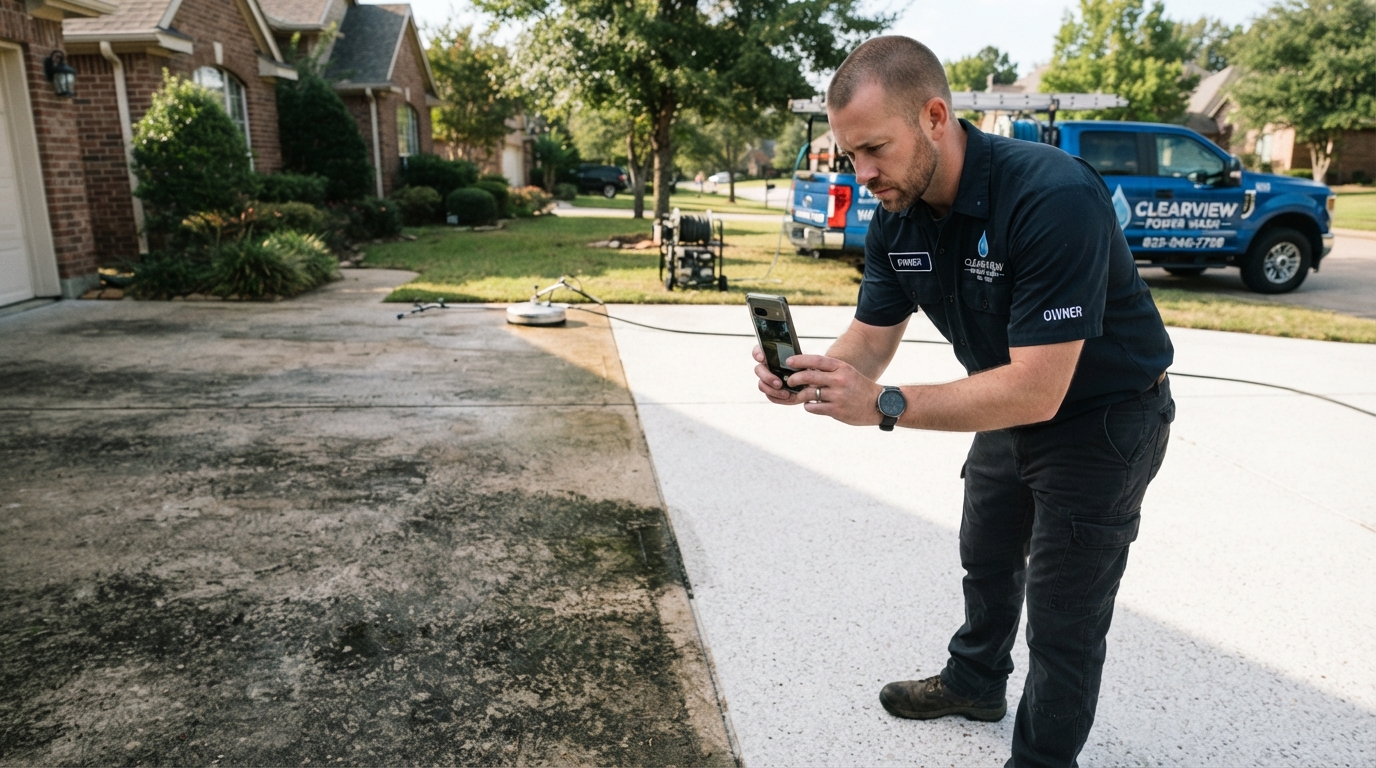
Facebook ads work for pressure washing companies when you target the right neighborhoods, use strong before/after visuals, and send traffic to a page that converts. This guide covers exactly how to set it up.
Most pressure washing companies run Facebook ads the wrong way. They boost a post, spend $200, get a handful of likes, and conclude that “Facebook doesn’t work for us.” It does work — just not the way most people run it.
Done right, Facebook and Instagram ads can fill your schedule with residential jobs, driveways, decks, and commercial contracts. Here’s what it actually takes.
Why Facebook Ads Work for Pressure Washing
Pressure washing is a visual service. You clean something, and the transformation is immediately obvious. Before/after photos and videos perform exceptionally well on social media because they stop the scroll and tell the whole story in one image.
Facebook also lets you target by location, homeownership status, household income, and neighborhood — which means you can put your ad in front of exactly the kind of homeowners who are likely to hire you. That’s a level of targeting that word-of-mouth and door hangers can’t match.
The Core Campaign Setup for Pressure Washing Facebook Ads
1. Choose the Right Campaign Objective
Don’t use “Boost Post.” Instead, go into Meta Ads Manager and set your campaign objective to Leads or Traffic (to a landing page). Leads gives you an instant form in-app. Traffic sends people to your website. Both can work — leads give you higher volume at lower cost, traffic gives you more qualified intent if your landing page is strong.
2. Nail Your Audience Targeting
For residential pressure washing:
- Target homeowners (use Meta’s “homeowners” demographic filter)
- Target by zip code or city radius around your service area
- Layer in household income targeting to focus on neighborhoods that can afford your service
- Test interest-based targeting: home improvement, outdoor living, home maintenance
For commercial contracts, run a separate campaign targeting business owners and property managers by industry. The creative and messaging will be completely different.
3. Use Before/After Creative
Your best ad is a before/after photo. One image showing a dirty driveway next to a clean one says more than any headline you can write. Video walkthroughs of jobs — even shot on a phone — also perform well.
If you don’t have strong photography, that’s a problem worth solving. Consider investing in professional photography and videography for your marketing materials. The ROI on quality visuals across ads, your website, and social media is substantial.
4. Write Ads That Speak Directly to the Pain
Don’t lead with your company name. Lead with what the customer cares about:
- “Your driveway is holding your curb appeal back.”
- “Your deck hasn’t been cleaned in years. Here’s what that costs you.”
- “Neighbors are noticing your algae problem.”
Then follow with your offer, your service area, and a clear call to action: “Get a free quote in 60 seconds.”
5. Send Traffic to a High-Converting Landing Page
Don’t send ad traffic to your homepage. Send it to a landing page built specifically to capture leads — with a headline that matches your ad, a quick form, and your contact number prominent. If your website isn’t built to convert visitors into leads, your ad spend is being wasted at the landing page stage.
Budget Guidance
You don’t need a massive budget to start. A realistic testing budget is $20–$30/day. That gives you enough impressions to gather data and optimize. Once you find an ad set that’s converting at a cost per lead you can work with, scale from there.
Expect your first two weeks to be a learning period. The Meta algorithm needs data to optimize. Don’t kill campaigns after three days — give them at least 7–10 days before making changes.
Retargeting: The Most Underused Tactic
Most pressure washing companies run cold ads and stop there. Add a retargeting campaign to your setup and you’ll pick up the leads who clicked but didn’t fill out the form.
Set up a website custom audience (anyone who visited your site in the last 30 days) and run a direct offer to them. Since they already know who you are, your retargeting ad can be much more direct: “Still thinking about it? Book this week and save $25.”
Common Mistakes and How to Avoid Them
A few strategies that separate successful campaigns from wasted budgets:
- Test multiple creative examples: Don’t run one ad. Create three to five variations and let Facebook identify which performs best. Small differences in headline or photo can produce dramatically different results.
- Be specific about your service area: Showing ads to people 50 miles away who would never hire you wastes budget. Be precise with your geographic targeting — the point of local service ads is local reach.
- Track your competitors: Use the Meta Ad Library to see what competitors in your market are running. You’ll find gaps in their messaging that you can exploit.
- Less time on vanity metrics: Likes and shares are less important than leads and calls. Judge campaign success by cost per lead, not engagement rate.
- Build a following of local homeowners: Growing your Facebook page followers in your specific market creates an owned audience you can reach without ad spend. Post consistently and boost your best-performing before/after content to accelerate growth.
Facebook Ads vs. Google Ads for Pressure Washing
These two platforms serve different purposes. Google Ads captures people who are already searching for pressure washing services — high intent, ready to buy. Facebook Ads creates demand and reaches people who aren’t searching yet but are the right profile to hire you.
The best pressure washing companies use both. Google Ads and Local Service Ads for bottom-of-funnel intent. Facebook for building awareness and staying in front of your target neighborhoods.
Real-World Examples and Campaign Templates
One of the most effective ways to improve your Facebook advertising is to study what’s already working. Here are specific examples of campaign approaches that work for this industry:
Example 1: The Neighborhood Saturator
Pick three to five zip codes with high homeownership rates and strong demographics. Create one campaign with a tight geographic radius around those neighborhoods. Run your best before/after video. The goal is to become the recognizable cleaning company in those specific neighborhoods — so when residents mention a dirty driveway at a neighborhood gathering, your name comes up. Strategies that create neighborhood-level brand recognition compound over time. Once you’re known in an area, referrals start coming in without ad spend.
Example 2: The Seasonal Push
Time your ad campaigns to seasonal demand peaks. In late March or early April, create a “spring cleaning” campaign featuring house washes and driveway cleaning. In October, push gutter cleaning and pre-winter deck washing. These campaigns don’t need a complex strategy — they just need to be in front of the right homeowners at the moment they’re already thinking about home maintenance. Keep the copy simple: “Spring is here. Is your house ready?” with a strong before/after photo.
Example 3: The Commercial Prospector
Create a Facebook campaign targeting business owners and property managers within a 20-mile radius of your service area. The creative should look different from your residential ads — professional, results-focused, emphasizing commercial capabilities and reliability. Run this campaign less time than your residential campaigns (commercial decisions take longer), but keep it running consistently to stay top of mind for decision-makers who may not be ready to switch vendors today but will be in six months.
These examples point to a consistent truth: the most successful Facebook advertisers in this industry don’t just boost posts. They create specific, targeted campaigns with photos that tell the story, copy that speaks to the customer’s point of frustration, and a clear next step. Stand out from other local contractors by looking more professional, more specific, and more relevant than the competition.
Tracking, Creative Strategy, and Scaling Ads That Work
Most contractors run Facebook ads without proper tracking. Here’s how to build a measurement system that actually tells you what’s working — and helps you spend smarter as you scale.
Set Up Conversion Tracking Before You Spend
Install the Meta Pixel on your website before running a single dollar of ads. This lets you track which ads are generating form fills and calls — not just clicks. Without tracking, you’re guessing. With it, you can explain to yourself exactly what your $500 in ad spend produced and optimize accordingly. Creative that doesn’t convert gets cut. Creative that converts gets scaled.
Explain Your Process in Ad Copy
A lot of homeowners are interested in cleaning services but have objections: “Will it damage my siding?” “Is it safe for my deck?” “What do you use?” Ads that briefly explain your process — “We use low-pressure soft wash safe for all surfaces” — remove objections and increase click-through rate. A short explanation in the ad copy pre-sells your professionalism before the prospect ever visits your website.
Stay Ahead of Competitors With Creative Rotation
Facebook and Instagram ads experience creative fatigue — the same creative shown to the same audience repeatedly gets fewer and fewer responses. Stay ahead of competitors by rotating new creative into your campaigns every 2–4 weeks. New photos from recent jobs, seasonal messaging, and updated offers all refresh your ad performance and prevent your campaigns from going stale. Track engagement and refresh any creative whose click-through rate has fallen significantly from its peak.
Platforms Worth Testing Beyond Facebook
Facebook and Instagram are the strongest platform options for local service businesses in terms of targeting precision. However, Nextdoor is worth testing for neighborhood-level ads — the audience is explicitly local and homeowner-heavy. Pinterest and YouTube can work for educational content, but for most contractors, Facebook and Instagram should capture the majority of your social ad budget before you experiment with other platforms.
Creating High-Converting Local Ads: A Practical Guide
Here’s a step-by-step approach to creating local Facebook ads that turn interested homeowners into booked jobs:
Step 1: Define Your Local Audience
Before you create a single ad, know your local target. Pick the neighborhoods or city areas you want to saturate. Create a separate ad set for each neighborhood or zip code cluster. Neighborhood-level targeting is one of the most powerful strategies available to local contractors — and most competitors skip it entirely.
Step 2: Create Winning Photos and Headlines
Your ad’s photos do more work than your headline. Create ads with side-by-side photos showing the before/after transformation. Use three to five photo variations so you can identify which photos produce the most responses from interested homeowners. Each headline should be direct and specific: “Driveways Cleaned in [City Name]” outperforms generic headlines every time.
Step 3: Write Copy That Explains and Converts
Don’t assume homeowners know what pressure washing involves. Explain your process in two to three sentences. Explain the difference between soft washing and high-pressure washing. Explain what surfaces you clean. An informed homeowner is a less price-sensitive homeowner — take the extra time to explain, and you’ll stand out immediately from competitors who just post a price and a phone number.
Step 4: Test Creative and Track Everything
Create three headline variations and two photo sets for every campaign. Test them against each other for at least seven days before making changes. Track your cost per lead, your click-through rate, and your conversion rate by neighborhood. Tracking this data across each platform you advertise on reveals which creative, which neighborhood, and which strategies produce the most affordable, high-quality leads. Competitors who don’t track this data are flying blind — you don’t have to be.
Step 5: Scale What Works, Kill What Doesn’t
After two weeks of data, you’ll have clear winners. Double the budget on winning ad sets. Pause losing creative. Success on Facebook advertising compounds: each round of testing makes your campaigns more efficient, your creative more relevant, and your cost per booked job lower. This iterative approach is the most reliable path to consistent, affordable lead flow from the platform.
Frequently Asked Questions
Start with $20–$30/day to test. Once you have a profitable campaign, scale to $50–$100/day. Most mid-size residential operations see strong results in the $500–$1,500/month range.
Yes, but with different targeting. Target business owners, property managers, and facilities decision-makers. Run separate campaigns from your residential ads. The messaging and visuals need to speak to commercial priorities — professional results, reliability, liability coverage.
Before/after side-by-side images consistently outperform single-image creative. Video walkthroughs of driveways, concrete, and siding also perform well. Close-up shots showing the cleaning in action (spray, steam, cleaned surface) stop the scroll effectively.
Test both. Lead Ads (in-platform forms) typically get higher volume at lower cost per lead. Traffic to a landing page often gets better quality leads. Start with Lead Ads, then set up a landing page test once you have baseline data.
Facebook ads can be one of the most cost-effective ways to fill your schedule — when they’re built correctly. The three pillars: target the right people in your service area, use visual creative that shows the transformation, and send leads to a page that captures them.
If your current digital marketing isn’t delivering a consistent flow of jobs, let’s talk about what’s missing.